
Canada vape rules can look straightforward on the surface: buy from a licensed retailer, be of legal age, stay within nicotine limits. But the moment provincial governments layer their own rules on top of federal law, things get complicated fast. Where you live, how old you are, what nicotine level is in your bottle, and whether you’re crossing a border all determine which rules actually apply to you.
Shopping from a long-standing Canadian online vape retailer removes a lot of that guesswork. Stores like Premium eJuice, which has been operating in the Canadian market since 2013, already stock products that meet federal standards, so you’re not left second-guessing compliance. That said, knowing the rules yourself is still worth the time, especially if you travel, live near a provincial border, or order products from outside the country.
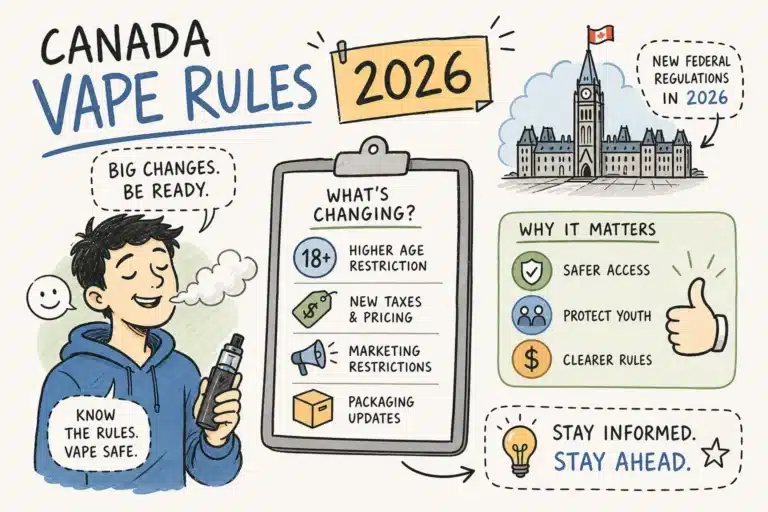
Here’s a clear breakdown of the five core areas every Canadian vaper needs to understand in 2026: the federal framework, legal purchase ages by province, nicotine and flavor restrictions, public-use rules, and customs regulations for travelers.
The federal framework: what the Tobacco and Vaping Products Act actually covers
Who the TVPA governs and what it regulates
The Tobacco and Vaping Products Act (TVPA) is the foundational federal law governing every vaping product sold or marketed in Canada. It applies to manufacturers, importers, retailers, and advertisers, not just the products themselves. E-liquids, pods, disposables, vape pens, and nicotine-containing devices all fall under its scope.
Health Canada enforces the TVPA and has recently strengthened its enforcement tools. As of early 2026, fines for non-compliant vaping products can reach $3,000 per offence, and additional TVPA offences have been designated as ticketable contraventions. Selling a vaping product to a minor, for example, now carries a $2,000 fine. The enforcement environment is meaningfully stricter than it was even two years ago.
Labeling, packaging, and advertising requirements
Every vaping product sold in Canada must carry bilingual health warnings (English and French), display the nicotine concentration, include an ingredient list, identify the manufacturer, and come in child-resistant packaging. These requirements are not optional, and retailers carrying products without compliant labels take on real legal risk.
Advertising is tightly restricted under federal law. No lifestyle marketing, no endorsements, no testimonials, no imagery that could appeal to youth, and no claims that a product is “safe” or “healthy.” Permissible advertising must include a health warning. One frequently asked question is whether a federal flavor ban is in effect: as of July 2026, the federal ban proposed in 2021 remains unimplemented. Health Canada has signaled openness to moving forward, but no timeline has been confirmed. This matters because provincial bans fill that gap unevenly across the country.
Canada vape rules on legal age: the 18, 19, and 21 split across provinces
How provinces divide on the legal purchase age
Federal law sets the minimum purchase age at 18, but provinces are free to raise it, and most have. For 2026, the split breaks down like this:
- Minimum age 18: Alberta, Quebec, Manitoba, and Saskatchewan
- Minimum age 19: British Columbia, Ontario, New Brunswick, Nova Scotia, Newfoundland and Labrador, Northwest Territories, Nunavut, and Yukon
Canadian online retailers are required to verify age at the point of purchase and again at delivery, so the province you’re shipping to determines which standard applies.
Why PEI is in a category of its own
Prince Edward Island is the only jurisdiction in Canada with a 21-year minimum purchase age, making it the most restrictive vaping market in the country by a wide margin. PEI also bans all non-tobacco flavors, restricts vape sales exclusively to tobacconist shops, and caps nicotine at provincial levels. If you’re ordering online and shipping to a PEI address, the retailer bears responsibility for meeting that 21-year age requirement. Online retailers shipping to PEI must verify age against this higher threshold and ensure products meet the province’s stricter flavor and nicotine rules.
Canada vape rules on nicotine limits and flavor bans: how the provinces divide
The federal nicotine cap
At the federal level, the TVPA sets a maximum nicotine concentration of 66 mg/mL for vaping products manufactured or imported for Canadian retail sale. This is the ceiling for products on store shelves across most of the country. However, two provinces have set significantly lower caps: Quebec and Nova Scotia both limit nicotine to 20 mg/mL, bringing them in line with the import limit that applies to travelers crossing the border (covered in the customs section below).
Provinces with complete flavor bans
Six jurisdictions have enacted full flavor bans, permitting only tobacco-flavored vaping products. Nova Scotia was first (April 2020), followed by PEI (March 2021), New Brunswick (September 2021, currently under constitutional challenge but still in effect), Northwest Territories (March 2022), Nunavut (May 2023), and Quebec (October 2023). Nova Scotia and Quebec are notable because their bans include mint and menthol, not just fruit and candy flavors. Quebec goes further: online sales of vaping products are entirely prohibited within that province, meaning no Canadian retailer can legally ship vaping products to a Quebec address.
Where flavors are restricted but not banned
British Columbia, Ontario, and Saskatchewan allow flavored vaping products, but only through licensed adult-only specialty vape stores. General retailers like convenience stores and gas stations in those provinces can only sell tobacco-flavored products, and in Ontario and Saskatchewan, mint and menthol are also permitted at general retail. Alberta, Manitoba, Newfoundland and Labrador, and Yukon currently have no provincial flavor restrictions beyond federal rules, giving vapers in those provinces the widest product access of any jurisdictions in the country.
Where vaping is restricted in public spaces
Indoor workplaces, transit, and shared spaces
Every province has extended its smoke-free or tobacco-free legislation to cover vaping. The practical result is consistent nationwide: if smoking is prohibited somewhere, vaping is too. Indoor workplaces, restaurants, bars, transit vehicles, hospitals, and school properties are off-limits across virtually every Canadian jurisdiction. The specific acts differ by province, Ontario’s Smoke-Free Ontario Act, BC’s Tobacco and Vapour Products Control Act, Quebec’s Tobacco and Vapour Products Control Act, but the baseline restrictions align closely enough that you can treat the rule as universal for enclosed public spaces.
Outdoor restrictions and city-level rules
Outdoor restrictions vary more significantly and often depend on municipal policy rather than provincial law. Playgrounds, sports fields, hospital entrances, and transit shelters are restricted in many cities. Calgary, Toronto, and Vancouver all have different policies for outdoor public spaces like parks and patios, so checking local bylaws is worthwhile if you spend time in those areas. The simplest practical rule: treat vaping the same as smoking in any shared or public space, and look for a designated smoking area if you’re unsure.
Crossing the border with vapes: customs and travel rules
Declaration and the 20 mg/mL nicotine limit at customs
All vaping products must be declared when entering Canada. Failing to declare them can result in confiscation and fines, so there’s no benefit to trying to slip them through. The key number to know at the border is 20 mg/mL: that’s the maximum nicotine concentration permitted on personal imports, regardless of what Canadian retailers sell domestically under the federal 66 mg/mL cap. Products exceeding 20 mg/mL will be confiscated at the border, no exceptions. High-nicotine e-liquids sourced from outside Canada are one of the most common points of customs friction for vapers.
Quantity limits for personal-use imports
Canada Border Services Agency allows up to 12 vaping containers with a combined maximum of 120 mL of liquid (or 120 g in solid form) as a personal-use import. Quantities beyond that threshold may be treated as commercial imports and face additional scrutiny. Duties and taxes may apply to declared vaping products even when they fall within those allowed limits, so don’t assume declaration equals duty-free entry.
Flying with vaping devices
Vaping devices and batteries must travel in carry-on baggage only, never in checked luggage, per Transport Canada rules and standard airline policy. E-liquids in carry-on must comply with the 100 mL per container rule, stored in a clear 1L resealable bag. Larger quantities of liquid can go in checked baggage, but the device itself, including all batteries, must stay with you in the cabin. Power the device off or remove the battery before boarding.
Why buying from a compliant Canadian retailer protects you
What retailer compliance means for the products you receive
A compliant Canadian online vape store carries products that have already cleared Health Canada’s TVPA requirements: correct bilingual labeling, child-resistant packaging, verified nicotine concentrations, and no prohibited marketing claims. When you order from a retailer that has been operating in the Canadian market for years, the products it stocks have already been checked against federal standards. You’re not left wondering whether the nicotine level on the label is accurate or whether the packaging meets Health Canada specifications.
The contrast with gray-market or cross-border products is significant. Products sourced outside Canada’s regulated supply chain may exceed the 20 mg/mL provincial limits in Nova Scotia or Quebec, carry no bilingual health warnings, use non-child-resistant packaging, or make health claims that are prohibited under the TVPA. Health Canada has taken enforcement action against consumers receiving non-compliant products, not just against sellers. Buying from a gray-market source shifts all of that compliance risk onto you.
Premium eJuice: over 12 years of compliant Canadian vape retail
Premium eJuice has been operating as a Canadian online vape retailer since 2013, making it one of the longest-running stores in the country. Every product in the catalogue is sourced to meet Canadian regulatory requirements, which means buyers across Canada (excluding Quebec, where online vape sales are prohibited) can order with confidence. The store ships nationwide via Canada Post, UPS, DHL, and Canpar at a flat rate of $4.99, backs its products with a coil and pod replacement guarantee for defective items, and offers bulk discounts of up to 20%. Staying compliant with Canada’s vaping rules doesn’t have to mean paying a premium for the privilege.
Putting it all together
Vape rules in Canada operate in layers. Federal law sets the floor through the TVPA, covering nicotine limits, labeling, packaging, and advertising. Provinces build on that floor with purchase ages, flavor restrictions, retail licensing rules, and public-use bans. Your specific situation, where you live, how old you are, and whether you’re traveling across borders, determines exactly which rules apply to you.
Three points of confusion are worth keeping front of mind: the difference between the federal 66 mg/mL domestic nicotine cap and the 20 mg/mL import limit at the border; the patchwork of provincial flavor bans ranging from none (Alberta, Manitoba) to total (Nova Scotia, Quebec, PEI); and PEI’s unique 21-year purchase age requirement, which stands alone in Canada.
Understanding canada vape rules is genuinely useful, but applying them correctly every time you restock is where most people run into trouble. If you’re ever uncertain whether a specific product meets Canadian standards, the simplest solution is to buy from a retailer that’s already done that work for you. Premium eJuice’s full product catalogue covers everything from starter kits and nicotine salts to disposables and pods, all sourced to meet federal compliance requirements. It’s the easiest way to restock without spending an afternoon cross-referencing provincial regulations.
For additional public-health context, see the Canadian Lung Association’s position statement on vaping.

Stuart Rosenfarb CEO & Founder of Premium eJuice
Premium eJuice (previously Premium eJuice Samples) was established in 2013 by Founder & CEO Stuart Rosenfarb with the mission of helping as many smokers as possible kick their smoking habit forever, by providing a selection of the highest quality and best-tasting eJuices on the market to ensure a successful and lasting transition from smoking to vaping.