
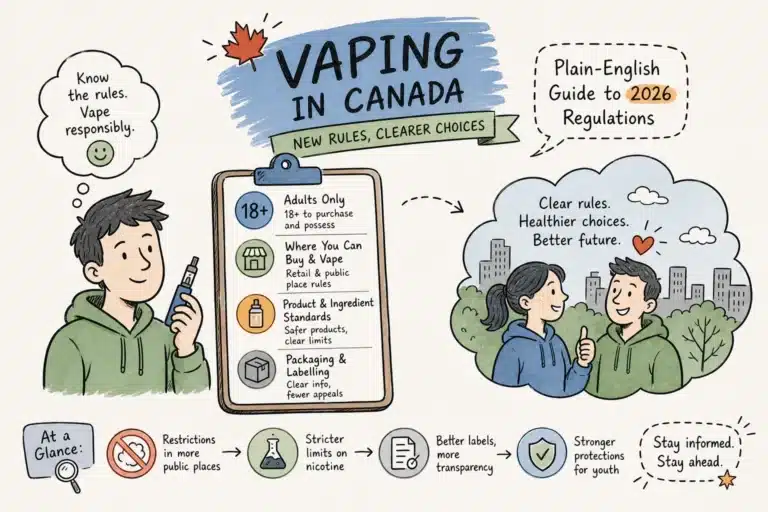
Canada’s vaping regulations are not one set of rules. They form a layered system where federal legislation sets the floor, and provinces stack their own requirements on top. That patchwork can be confusing for consumers, whether they’re shopping for their first pod kit or have been ordering online for years. The rules around nicotine limits, minimum purchase age, flavour availability, and packaging requirements genuinely differ depending on where you live and where you buy.
The good news is that buying from a reputable Canadian online retailer like Premium eJuice takes most of that guesswork off your plate. Retailers who build compliance into every step of the process, from product selection to checkout, make it easier to shop within the rules without having to audit every label yourself.
This guide breaks down what you actually need to know for 2026: the federal framework under the Tobacco and Vaping Products Act, the nicotine concentration cap, how provincial age rules differ, where flavour bans apply, and what compliant packaging looks like. No legal jargon, just the facts about vaping regulations in Canada.
Vaping regulations Canada: the federal foundation
What the Tobacco and Vaping Products Act actually does
The Tobacco and Vaping Products Act (TVPA) replaced Canada’s former Tobacco Act in May 2018 and introduced the first legal framework designed specifically for vaping products. Its core purpose is dual: protect young people from nicotine addiction while preserving adult access to vaping as a less harmful alternative to smoking. The Act regulates the manufacture, sale, labeling, and promotion of vaping products sold anywhere in Canada. For anyone who wants to read the full text, the Justice Laws Website at Tobacco and Vaping Products Act (full text) is the authoritative source and is kept current.
How the NCVPR fits into the bigger picture
The Nicotine Concentration in Vaping Products Regulations (NCVPR) is not a separate law. It operates as a regulation made under the TVPA, which means it carries the same legal weight. The NCVPR came into force on July 8, 2021, and sets the specific nicotine cap that governs every product sold on Canadian shelves. Together, the TVPA and the NCVPR form the backbone of Canada’s federal vaping regulations. Provincial additions, packaging mandates, and advertising restrictions all build on this foundation. The regulation was published in the Canada Gazette (see the Canada Gazette publication of the NCVPR).
Canada’s 20 mg/mL nicotine cap: what it means for you
How the cap changes what’s on the shelf
Under the NCVPR, no vaping product sold in Canada can contain more than 20 mg/mL of nicotine. Products cannot be packaged, imported, or sold domestically if the stated concentration on the label exceeds that limit. This affects what’s available here compared to some other markets. In the United States, for example, high-nicotine salt formulations at concentrations above 20 mg/mL are commonly available. For pod and salt nic users in Canada, 20 mg/mL is the ceiling, full stop; see reporting that explains how the Canadian cap compares to other jurisdictions in more detail (Global News coverage of Canada’s nicotine cap).
Retailers who carry products labelled “Bold 50” or similar high-concentration names without reformulation for the Canadian market are operating outside federal law. When you shop from a compliant Canadian retailer, every product in the catalogue already reflects this cap. When in doubt, check the nicotine concentration statement on the label before purchasing.
The export exception and why it doesn’t affect you
The NCVPR does reference a 66 mg/mL limit, and this confuses vapers who come across it online. According to Health Canada backgrounder on the nicotine concentration limits, that higher limit applies exclusively to products manufactured in Canada for export to other markets. It has no bearing on anything sold to a Canadian address or available through a Canadian storefront. If a product on a domestic shelf claims a nicotine concentration above 20 mg/mL, it is non-compliant regardless of any export provision in the regulation.
Age-of-sale rules: how old do you need to be across Canada?
Federal baseline vs. what provinces actually enforce
The TVPA sets the federal minimum purchase age at 18. No province or territory can allow sales below that threshold. In practice, most of the country has set the bar higher. Most jurisdictions require buyers to be 19, matching the legal age for alcohol and tobacco in those regions. That group includes British Columbia, Ontario, Nova Scotia, New Brunswick, Newfoundland and Labrador, Manitoba, and all three territories. Alberta, Quebec, and Saskatchewan align with the federal floor at 18.
The logic here is straightforward: provinces have full authority to raise the minimum age above 18, but they cannot lower it. This means the legal purchase age where you live governs what you can buy, not just where you can walk into a store. Online purchases are subject to the same provincial rules as in-store sales.
The outlier: PEI’s 21 rule and what it means for online buyers
Prince Edward Island stands alone as the strictest jurisdiction in Canada, with a minimum purchase age of 21. That applies to every sale, including online orders shipped to a PEI address. Any legitimate Canadian online retailer operating within the law is required to verify age and apply provincial purchase restrictions at checkout. This isn’t a technicality; it’s a legal obligation on the retailer, not just a suggestion for the buyer.
Vaping regulations Canada: flavour bans by province
Which provinces have banned or restricted flavoured vaping products
As of 2026, six provinces and two territories have enacted flavour bans or restrictions, and the rules are not identical across all of them. Nova Scotia was the first to act, banning flavoured vaping devices as of April 1, 2020, with only tobacco-flavour products permitted. Quebec followed with a prohibition on all non-tobacco flavours, effective October 31, 2023. New Brunswick, Prince Edward Island, Newfoundland and Labrador, and Alberta all have bans in place. In the territories, the Northwest Territories and Nunavut also restrict sales to tobacco-flavour products only.
Ontario, British Columbia, and Saskatchewan operate under partial restrictions rather than full bans. In Ontario, flavours other than tobacco, mint, and menthol are restricted to specialty vape shops. British Columbia limits non-tobacco flavoured liquids to age-restricted specialty retailers. Saskatchewan enforces a similar specialty-shop-only rule for non-tobacco, non-mint, and non-menthol products. Manitoba and the remaining provinces without full bans still allow a broad range of flavour profiles through general retail.
What’s still available under federal law and where things stand nationally
The federal government has not enacted a nationwide flavour ban, despite having announced intentions to restrict sales to mint, menthol, and tobacco flavours as far back as 2021. That delay has created a genuinely uneven landscape across the country. Where you live in Canada directly determines what flavour products you can legally purchase. Online retailers must build this into their ordering systems, restricting certain products from being shipped to addresses in provinces where those flavours are prohibited.
For vapers in Ontario, Manitoba, and Saskatchewan, a broad range of flavour profiles including fruit, dessert, menthol, candy, and beverage options remains available through compliant retailers, subject to any applicable specialty-shop channel rules. For those in Quebec, Nova Scotia, New Brunswick, PEI, Alberta, Newfoundland and Labrador, the Northwest Territories, and Nunavut, only tobacco-flavour products are legal.
Packaging, labeling, and advertising: the rules behind the label
What must appear on every vaping product sold in Canada
The Vaping Products Labelling and Packaging Regulations (VPLPR) set out specific requirements for every product on a compliant retailer’s shelves. Products containing nicotine must display a standardized health warning covering 40% of the principal display panel, in both English and French. The VPLPR also requires a standardized nicotine concentration statement on any nicotine-containing product. Products with nicotine at or above 0.1 mg/mL must also carry a toxicity warning, a hazard symbol, and first-aid information for nicotine poisoning.
Every vaping substance, regardless of nicotine content, requires a full ingredient list using commonly recognized names without abbreviations, along with flavour indicators that identify which ingredients contribute to the product’s flavour profile. Child-resistant packaging is mandatory for all nicotine-containing substances and for refillable vaping devices. None of this is optional, and any product missing these elements is not legally compliant for Canadian sale.
Advertising restrictions and the public-space ban
The Vaping Products Promotion Regulations prohibit advertising in any public space where youth could be present, including retail locations and online stores accessible to the general public. Lifestyle advertising, testimonials, sponsorships, and anything that could appeal to young people are all prohibited. The only permitted advertising is factual information advertising or brand preference advertising, and only in adult-only establishments. Any permitted advertising must still include the required nicotine and health warning information.
What compliance actually looks like for Canadian online retailers
Age verification at the point of sale for online orders
Reputable Canadian online vape retailers are expected to verify the buyer’s age on every order, not just in physical stores. This typically involves an age declaration at checkout, provincial-specific purchase gates built into the ordering system, and in some cases, ID verification on delivery. The burden falls on the retailer, and compliant stores treat this seriously. The difference between a legitimate online vape retailer and an unregulated one is often visible right at checkout.
How Premium eJuice approaches compliance
Premium eJuice has been operating as a Canadian online vape retailer since 2013. Age verification is applied at checkout, the product catalogue is curated to reflect Canada’s 20 mg/mL nicotine cap, and shipping is managed to align with provincial rules, including flavour restrictions by destination province. That means customers in regulated markets receive only the products available to them under their province’s rules. The retailer’s vape juice selection and product listings are organised with those limits in mind.
For vapers who want consistent, straightforward access to compliant products, Premium eJuice also offers a coil and pod replacement guarantee and $4.99 flat-rate shipping across Canada. Compliance and value aren’t in conflict when the retailer has made both a priority.
Navigating Canada’s vaping regulations with confidence
Canada’s vaping regulations are layered, but they follow a clear logic once you understand the structure. The TVPA and the NCVPR establish the national rules on nicotine concentration, minimum age, labeling, and advertising. Provinces then apply their own requirements on top, particularly around minimum purchase age and flavoured product availability. Those provincial differences are real and legally enforceable, whether you’re buying in-store or online. Understanding Canada’s e-cigarette regulations and the Canada vape law as it stands in 2026 puts you in a much better position to shop confidently.
The simplest way to stay on the right side of these rules is to buy from a retailer that has already done the compliance work. That means age verification at checkout, a product selection that respects the legal nicotine limit in Canada, and order restrictions that reflect where you live. Premium eJuice was built around exactly that standard, and over a decade of serving Canadian vapers reflects that commitment. Shop with a retailer that knows the rules, and the complexity of Canada’s vaping regulations becomes someone else’s job to manage.

Stuart Rosenfarb CEO & Founder of Premium eJuice
Premium eJuice (previously Premium eJuice Samples) was established in 2013 by Founder & CEO Stuart Rosenfarb with the mission of helping as many smokers as possible kick their smoking habit forever, by providing a selection of the highest quality and best-tasting eJuices on the market to ensure a successful and lasting transition from smoking to vaping.